Luxury Vinyl Plank (LVP) has become the dominant hard surface flooring choice for homeowners — and with good reason. It’s waterproof, durable, realistic-looking, and available at a wide range of price points. But when you start shopping, you’ll quickly encounter two acronyms that can cause confusion: SPC and WPC. Both are types of rigid-core LVP, and both are excellent products. The difference lies in what’s inside the plank — and that difference matters more than most people realize.
What Does ‘Rigid Core’ Mean?
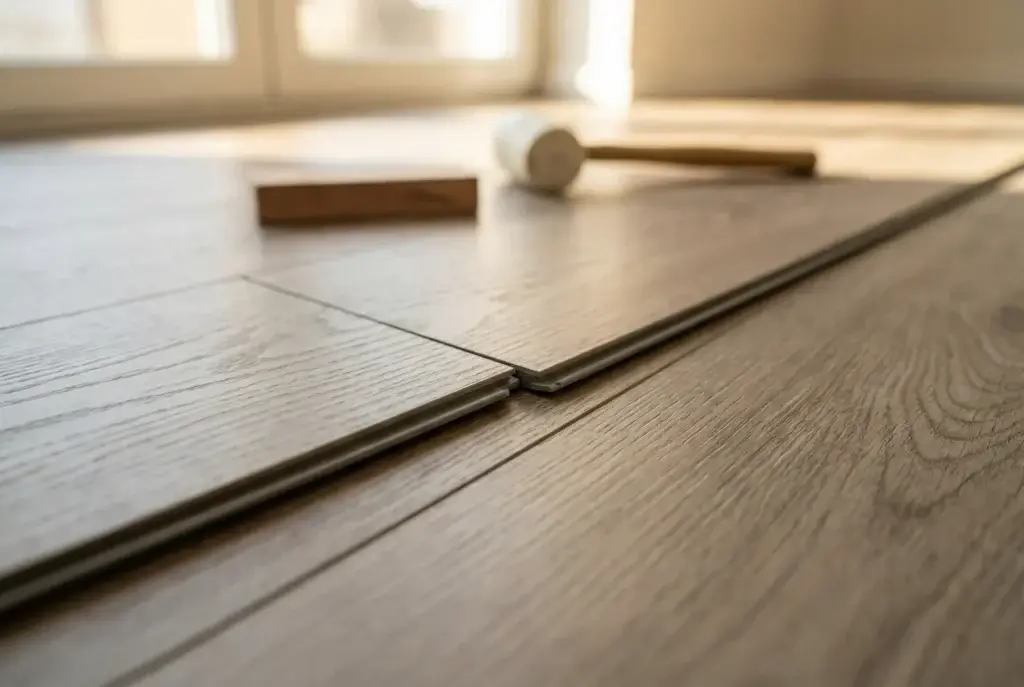
Traditional LVP was a flexible product — it could be rolled up and had some give to it. Rigid-core LVP, introduced in the mid-2010s, changed everything. A rigid core makes the plank dimensionally stable, meaning it resists expansion and contraction more effectively, feels more solid underfoot, and can be installed over minor subfloor imperfections that would cause problems for flexible vinyl. Both SPC and WPC are rigid-core products — the difference is in what that core is made of.
SPC: Stone Plastic Composite
SPC stands for Stone Plastic Composite (sometimes called Stone Polymer Composite). The core is made from a dense mixture of limestone powder, PVC, and stabilizers. This creates an extremely hard, rigid plank that is highly resistant to denting and indentation. SPC is thinner and denser than WPC — typically 4–6mm total thickness — which makes it ideal for installations where height transitions matter (such as connecting to existing flooring in adjacent rooms). Because of its density, SPC is also more dimensionally stable in temperature extremes, making it a strong choice for spaces that experience significant heat or cold fluctuations, such as sunrooms or three-season rooms. The trade-off is that SPC can feel slightly harder underfoot, and it transmits sound more readily than WPC.
WPC: Wood Plastic Composite
WPC stands for Wood Plastic Composite (sometimes called Wood Polymer Composite). The core is made from a foamed polymer blend — often incorporating wood flour or bamboo dust — that creates a lighter, slightly softer plank. WPC is typically thicker than SPC, ranging from 6–8mm or more, and that extra thickness combined with the foamed core gives it a noticeably warmer, more cushioned feel underfoot. WPC is also better at absorbing sound, making it a popular choice for upper-floor installations, apartments, and any space where noise transmission is a concern. The trade-off is that WPC is slightly less dimensionally stable than SPC in extreme temperature environments, and its softer core makes it marginally more susceptible to heavy indentation from furniture legs or high heels.
Which Should You Choose?
The right choice depends on your specific situation. If you’re installing in a space with significant temperature swings, need a thinner profile for height transitions, or want maximum dent resistance, SPC is likely the better fit. If you prioritize comfort underfoot, sound absorption, or are installing on an upper floor, WPC’s warmer feel and acoustic properties give it the edge. In most standard residential applications — living rooms, bedrooms, kitchens — either product will perform beautifully. The wear layer thickness (see our article on wear layers and AC ratings) and the quality of the manufacturer matter far more than the core type for most homeowners.
A Note on Marketing Claims
It’s worth noting that the LVP industry’s terminology is not always consistent. Some manufacturers use ‘SPC’ and ‘WPC’ loosely, and product lines marketed as WPC may have cores that are closer to SPC in composition. When evaluating products, focus on the total thickness, the wear layer thickness (in mils), the AC rating, and the warranty terms — these are the metrics that most reliably predict real-world performance. Your flooring professional can help you decode the spec sheet and find the product that genuinely fits your needs.
The Bottom Line
Both SPC and WPC are excellent flooring choices that will outperform traditional vinyl in virtually every measurable way. Understanding the difference helps you have a more informed conversation with your flooring professional and ensures you end up with a product that’s genuinely right for your home — not just whatever happens to be on sale.